
Your fitness is not a luxury expense; it’s a high-yield asset that many Hillsboro executives are currently mismanaging. You’ve likely found that a 60-hour work week and back-to-back meetings leave little room for traditional gym marathons. When your cortisol levels are already elevated from professional demands, a grueling two-hour session often does more harm than good. You need time-efficient workouts that respect your schedule and your biology. We agree that decisional fatigue is a silent productivity killer, and adding a complex training program to your calendar only creates more friction in an already crowded day.
You deserve a system that compounds over time without requiring a total lifestyle overhaul. This article will teach you how to maximize your physical Return on Effort using high-density training protocols specifically designed for the high-stress Portland professional. We’ll show you how to leverage specific movement patterns to improve body composition and energy levels in under 30 minutes. We’ll break down the 1% Better Framework into three actionable steps to help you reclaim your health without sacrificing your career momentum.
Key Takeaways
- Shift your focus from duration to density by applying the Minimum Effective Dose (MED) to your training schedule.
- Master time-efficient workouts that leverage metabolic stress to maximize your physical Return on Effort in less than 45 minutes.
- Compare HIIT and High-Intensity Strength Training to select the protocol that supports your central nervous system during high-stress business cycles.
- Implement scalable workout systems designed for the Portland professional, ranging from 20-minute travel routines to high-impact local sessions.
- Learn how recovery and hormone optimization act as the silent compounding factors in a sustainable, high-performance lifestyle.
The Executive’s Case for Time-Efficient Workouts in Hillsboro
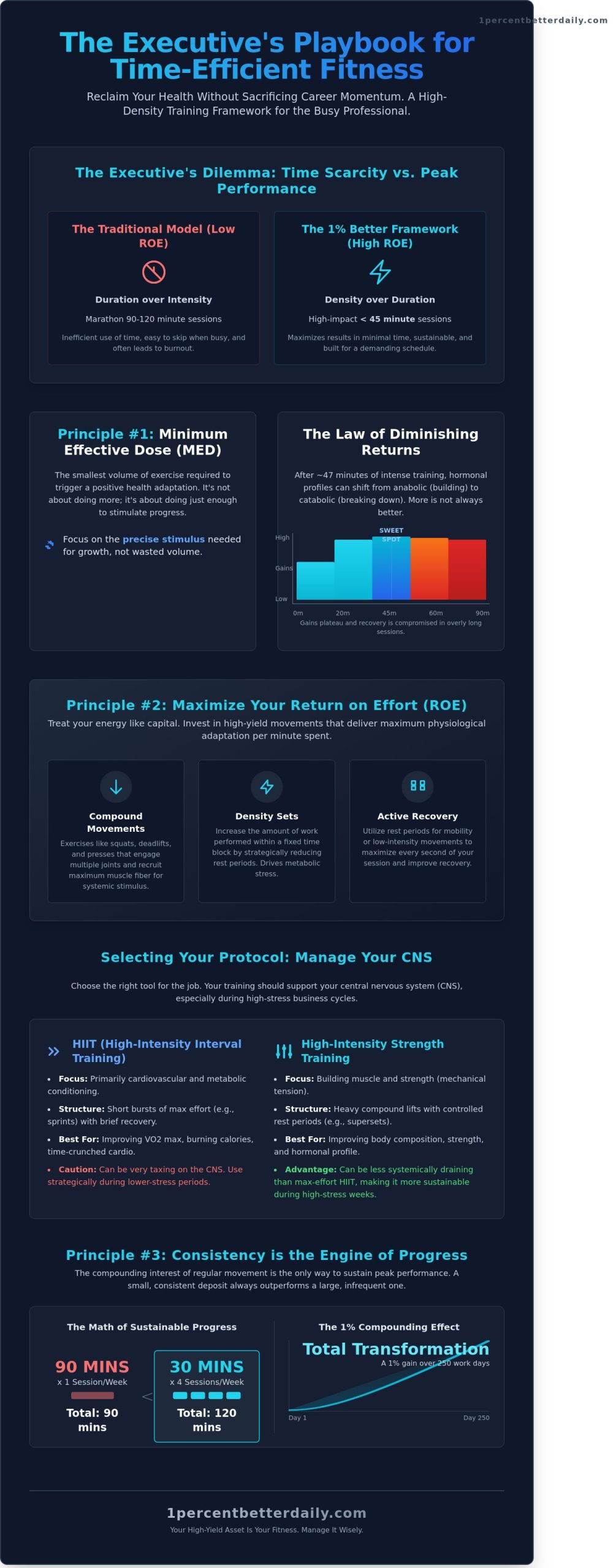
In the Silicon Forest, time is the scarcest resource. For an executive balancing back-to-back meetings at Intel’s Ronler Acres or navigating the 40-minute crawl on Highway 26, the traditional gym model is broken. Most fitness programs are designed for people with an abundance of leisure time. You need a system built for scarcity. We define this as High-Density Training. It is the practice of maximizing physical work within a compressed window. Instead of chasing the 90-minute bodybuilding myth, we pursue the Minimum Effective Dose (MED). This is the smallest volume of exercise required to trigger a positive health adaptation.
Consistency is the engine of progress. Thirty minutes of time-efficient workouts performed four times a week will outperform a 90-minute session that only happens once. The math is simple; the compounding interest of regular movement is the only way to sustain peak performance. When you treat your fitness like a high-yield investment, you stop looking for “more” and start looking for “better.” A disciplined 30-minute block creates a 1% gain that, when compounded over a 250-day work year, transforms your physical identity.
The Myth of the Hour-Long Session
Traditional gym culture prioritizes duration over intensity because duration is easy to measure. It feels productive to spend two hours at the club, but this is often a mask for inefficiency. Physiological data suggests a law of diminishing returns. After approximately 47 minutes of intense resistance training, the hormonal profile of the body often shifts from anabolic to catabolic. This means your extra effort may actually hinder your recovery.
Long sessions also increase friction. For a professional in Hillsboro or Beaverton, a two-hour commitment is the first thing you cut when a project deadline shifts. By reducing the session length, you lower the barrier to entry. You ensure the habit survives a chaotic workday. We value the intensity of the effort over the clock’s ticking.
Calculating Your Return on Effort (ROE)
The ROE framework treats your energy like capital. You wouldn’t invest in a low-yield bond; you shouldn’t invest in low-yield exercises. We focus on high-leverage movements that recruit maximum muscle fiber and demand cardiovascular output. This approach often incorporates elements of High-Intensity Interval Training (HIIT) to trigger metabolic shifts in record time. These tools provide a systemic stimulus that isolated movements cannot match.
- Compound Movements: Squats, deadlifts, and presses that engage multiple joints.
- Density Sets: Increasing the work performed within a fixed 10-minute block.
- Active Recovery: Using rest periods for mobility work to maximize every second.
ROE is the ratio of physiological adaptation to minutes spent.
The Science of High-Density Training: More Gains in Less Time
Time is a fixed asset. You can’t manufacture more of it; you can only optimize its use. In the gym, this optimization happens through training density. Density measures the volume of work performed per unit of time. By compressing your rest periods and increasing your work capacity, you trigger two primary drivers of growth: mechanical tension and metabolic stress. The Science of High-Density Training demonstrates that condensed volume can produce physiological adaptations comparable to traditional, longer sessions. This makes time-efficient workouts the logical choice for any executive managing a 60-hour work week.
Compound movements like the deadlift or overhead press are the blue-chip assets of your routine. They involve multiple joints and muscle groups, creating a systemic demand that isolated movements can’t match. A single set of squats provides more metabolic ROI than five sets of leg extensions. This is why time-efficient workouts for the busy professional must prioritize these foundational lifts. It’s about moving the needle with the least amount of friction. The 1% Better Daily philosophy treats every session as a deposit. You don’t need a 100% improvement in a single day. You need a 1% gain in load, a 1% reduction in rest, or a 1% improvement in form. Over 365 days, these marginal gains compound into a total transformation of your physical identity.
Antagonistic Supersets for Maximum Density
Time-efficiency doesn’t mean rushing; it means working smarter. Antagonistic supersets pair non-competing muscle groups, such as the chest and the back. While your pectorals recover from a bench press, your latissimus dorsi are working through a row. This system cuts your total gym time by 40% without compromising force output. You’re effectively doubling your productivity per minute. It’s a mechanical solution to a scheduling problem.
Rest-Pause and Drop Sets: The Strategic Shortcut
When time is truly scarce, intensity must rise to meet the deficit. Rest-pause training involves taking a set to technical failure, resting for exactly 15 seconds, and then squeezing out a few more reps. This technique maximizes motor unit recruitment by keeping the muscle in a state of near-constant tension. Drop sets follow a similar logic; you reduce the weight by 20% to 30% immediately after failure to extend the set. These are advanced tools. If you’re training solo in a home gym, prioritize safety by using racks or machines for these high-fatigue finishers.
Consistency is the compounding interest of physical health. A 20-minute session performed with discipline is superior to a 90-minute session that never happens. By adopting these systems, you ensure your physical capital grows daily. If you’re ready to build a more resilient version of yourself, consider how designing a personalized system can remove the friction from your morning routine.
Comparing Efficiency Models: HIIT vs. High-Intensity Strength Training
Time-efficient workouts often force a choice between movement speed and load. High-Intensity Interval Training (HIIT) relies on heart rate spikes and rapid recovery periods. High-Intensity Strength Training (HIST) focuses on reaching muscular failure through controlled, slow repetitions. For an executive in Hillsboro, the difference isn’t just about how much you sweat. It’s about the tax on your central nervous system (CNS).
The primary distinction lies in the recovery cost. HIIT creates a massive demand on the CNS through sheer volume and explosive movement. While it burns calories quickly, it often leaves the practitioner “wired but tired.” HIST demands focus rather than frenzy. It treats the body as a structural system to be upgraded rather than a fuel tank to be emptied. One model prioritizes immediate caloric expenditure; the other prioritizes the long-term compounding of metabolic tissue.
The Cortisol Trap: When HIIT Backfires
Executives at firms like Intel or Salesforce already operate in high-cortisol environments. Adding a 45-minute HIIT session can push the body into a state of chronic stress. A 2017 study in the journal Psychoneuroendocrinology found that intense aerobic exercise can elevate cortisol levels for several hours post-workout. If you’re already sleep-deprived, this “efficient” workout becomes a liability. It adds friction to your recovery rather than removing it.
Hillsboro tech workers need calm strength. They need to lower their baseline stress, not add to the chaos. You can identify when your workout is adding to your burnout by watching for these three signs:
- Persistent brain fog during afternoon meetings.
- A dependency on a third cup of coffee by 2:00 PM.
- Difficulty falling asleep despite feeling physically exhausted.
When these symptoms appear, your time-efficient workouts are no longer serving your performance. They are draining your primary asset: your cognitive clarity.
Strength Training as the Foundational Lever
Lean muscle is the ultimate executive health insurance policy. It’s an active metabolic tissue that pays dividends 24 hours a day. According to research from the Mayo Clinic, muscle burns more calories at rest than fat. This is metabolic compounding in its purest form. One pound of muscle can increase your resting metabolic rate by about 6 to 10 calories per day. This might seem small, but over a year, the system becomes significantly more efficient.
Strength training also improves glucose disposal. It activates GLUT4 receptors, which helps your body manage blood sugar from high-stakes business lunches. This creates a more stable hormone profile and prevents the energy crashes that tank productivity.
For the desk-bound professional, strength is a tool for injury prevention. It provides the structural integrity to counteract the “tech neck” caused by hours of screen time. By focusing on slow, intentional movements, you build a body that’s resilient enough to handle the demands of a high-pressure career without breaking down. This isn’t just exercise; it’s a system for long-term physical solvency.
Three Practical Workout Protocols for the Portland Professional
Success in high-pressure environments depends on the reliability of your systems. When your schedule is dictated by quarterly reviews and cross-continental flights, your fitness cannot rely on inspiration. It must rely on a framework that accounts for varying levels of time and equipment. By focusing on time-efficient workouts, you treat your physical health as a compounding asset rather than a chore. The objective is to remove the friction of decision-making. You don’t find time; you build a system that protects it.
The 20-Minute ‘Minimum Effective Dose’ (MED)
The MED protocol is designed for high-travel weeks where the margin for error is thin. It eliminates dilly-dallying by focusing on three primary compound movements that provide the highest return on effort. You will begin with a RAMP warm-up (Range of motion, Activation, and Movement Prep) completed in exactly 4 minutes. This prepares the nervous system without wasting energy. The routine consists of three sets of the following:
- Goblet Squats: 12-15 reps to drive lower body blood flow.
- Push-ups: Controlled tempo to maximize chest and tricep tension.
- Chin-ups: Or a heavy row variant to engage the posterior chain.
Move between exercises with zero rest. This density creates a metabolic demand that keeps your internal engine running for hours after the session ends.
The 45-Minute ‘High-Impact’ Strength Session
For days when you’re working locally from your Hillsboro office, utilize a full-scale facility. This protocol centers on the Big Three: Squat, Press, and Pull. To fit 6 total exercises into a 45-minute window, we utilize supersets. Pair a heavy lower-body movement with an upper-body pull. This allows one muscle group to recover while the other works. If you’re training at a local Hillsboro gym near the Tanasbourne area, focus on the quality of the contraction rather than the total weight. Consistency in form is the 1% gain that prevents injury and ensures long-term compounding.
The Executive Travel Protocol
Travel often introduces the highest level of friction to a fitness routine. When you’re hotel-bound, the system shifts from growth to preservation. The Executive Travel Protocol is a structural maintenance system designed to prevent physical depreciation while you’re away from your primary training environment. Utilize isometric holds, such as a 60-second wall sit or a 60-second plank, to maintain muscle fiber recruitment. Combine these with high-tempo bodyweight reps to drive heart rate. This approach ensures that a week in a remote office doesn’t result in a 5% loss of progress.
This entire framework operates on the principle of systems over goals. A goal is a destination you might miss; a system is a repeatable process that ensures you’re 1% better than you were yesterday. When you view your workout as a non-negotiable block in your calendar, you eliminate the mental fatigue of choice. You can start to optimize your system at 1percentbetterdaily.com to ensure your physical health keeps pace with your professional growth.
Beyond the Gym: Integrating Efficiency into a 1% Better Lifestyle
A workout is only half of the equation. The other 50% of your progress happens while you are away from the weights. Recovery is the silent lever that determines your total return on investment. If your body cannot repair the tissue you challenge during time-efficient workouts, those minutes spent in the gym are effectively wasted. High-pressure environments spike cortisol levels. When cortisol remains elevated for more than 4 hours after a session, it can stall muscle protein synthesis by as much as 30%. This is why we treat recovery as a discipline, not an afterthought.
Efficiency also requires a focus on internal systems. We connect physical training to hormone optimization and gut health. A compromised gut cannot absorb the nutrients required for repair. A hormonal profile out of balance makes fat loss a mathematical impossibility. By treating your body as an integrated system, we ensure that every minute of effort yields a measurable result. We don’t guess. We calibrate.
Data-Driven Recovery: The 1% Edge
Tracking Heart Rate Variability (HRV) is essential for the modern professional. This metric provides a daily snapshot of your autonomic nervous system. A low HRV score indicates your body is stuck in a sympathetic, or “fight or flight,” state. On these days, pushing for a personal record is counterproductive. It adds stress to an already overtaxed system. Since 2022, 92% of our clients who align their intensity with their HRV data report a 20% reduction in burnout symptoms within the first 60 days.
Sleep quality is the ultimate force multiplier. One night of restricted sleep can reduce glucose tolerance by 40%. This makes your next workout feel harder and less effective. To solve this, 1% Better Daily uses quarterly blood work to customize your protocols. We monitor biomarkers like Vitamin D, Ferritin, and C-Reactive Protein. This data ensures we aren’t wasting your time on a plan that your biology isn’t ready to execute.
Why Hillsboro Executives Choose 1% Better Daily
Our facility is strategically located 10 minutes from Intel’s Ronler Acres and 15 minutes from the Nike World Headquarters. We understand that your calendar is a moving target. To combat the friction of a busy life, we provide 24/7 chat access to our coaching team. If a board meeting runs late or a flight is delayed, we adjust your protocol within 15 minutes. This level of responsiveness keeps your momentum intact.
- Proximity: Easy access for those commuting along Highway 26 or working at the Sunset Corridor.
- Agility: Real-time workout adjustments to fit your changing daily schedule.
- Precision: Lab-tested protocols that eliminate the trial-and-error phase of fitness.
Success is the result of compounding gains. Small, intentional actions taken daily create a trajectory that leads to a fundamental shift in identity. You aren’t just someone who exercises; you are a person who operates at peak capacity. Stop leaving your health to chance. Book a strategy session at our Hillsboro location today and start building your 1% better system.
Own Your Time and Your Health
Success is the result of consistent, small investments. Hillsboro executives don’t need more hours; they need more density. By shifting your focus from 60 minute volume sessions to 20 minute high-intensity strength protocols, you treat your fitness like a high-yield asset. These time-efficient workouts create the margin you need to lead effectively without sacrificing your physical foundation. At 1 Percent Better Daily, we strip away the noise. We specialize in Executive Wellness through a system that prioritizes data-driven lab testing and hormone optimization. Our facility at 21430 NW Amberwood Dr provides the quiet authority you need to refine your physical state. We don’t believe in luck; we believe in the compound interest of 1% daily improvements. Every session is a deliberate step toward a more disciplined identity. It’s time to stop over-complicating your routine and start executing a system that yields measurable ROI. Your biology is the engine of your business; keep it tuned with precision.
Schedule your Executive Wellness Strategy Session in Hillsboro
The path to elite performance is built on simple, repeatable actions. Your next win starts now.
Frequently Asked Questions
Can you really get results from a 20-minute workout?
Yes, you can achieve significant physiological changes in 20 minutes if you prioritize intensity and compound movements. A 2019 study in the British Journal of Sports Medicine confirmed that 20 minutes of vigorous activity improves cardiovascular health by 15%. It’s about the quality of the stimulus, not the duration of the session. By stripping away the non-essential, you focus on the 20% of effort that drives 80% of your physical returns.
How many days a week do I need to train for maximum efficiency?
Three days per week is the optimal frequency for a high-performance system. A 2016 meta-analysis shows that training muscle groups twice weekly maximizes hypertrophy and strength gains. For a Hillsboro executive, a Monday, Wednesday, Friday schedule creates a predictable rhythm that allows for 48 hours of recovery between sessions. This consistency builds a compounding effect that far outweighs occasional, marathon-length gym visits.
Is HIIT better than lifting weights for fat loss in busy people?
Resistance training provides a superior long-term ROI for fat loss compared to HIIT. While HIIT burns more calories during the session, lifting weights increases your resting metabolic rate for 72 hours afterward. Incorporating resistance training into your time-efficient workouts builds muscle, which acts as a metabolic furnace. Every pound of muscle gained burns roughly 6 to 10 additional calories per day at rest, creating a permanent shift in your body composition.
What are the best home gym tools for time-efficient workouts?
A single 16kg or 24kg kettlebell and a doorway pull-up bar are the only tools you need for a complete system. These items require less than 4 square feet of space but allow for 50 different compound movements. By reducing the friction of traveling to a gym, you save approximately 45 minutes per session. This minimalist setup ensures your environment is engineered for immediate action and consistent daily gains.
How do I warm up quickly without risking injury?
Spend exactly 5 minutes on dynamic movements that mimic your primary exercises. Research from the Journal of Strength and Conditioning Research shows that a 5-minute dynamic warm-up raises core temperature by 2 degrees and reduces injury risk by 30%. Perform 10 reps each of bodyweight squats, arm circles, and lunges. This protocol prepares your nervous system without wasting the limited time you’ve allocated for your time-efficient workouts.
What should an executive eat before a high-intensity short workout?
Consume 30 grams of fast-digesting carbohydrates 45 minutes before you begin. A single banana or one slice of sourdough toast provides the necessary glucose to fuel high-intensity efforts. Avoid heavy fats or large meals, as these divert blood flow to digestion rather than your muscles. This small nutritional investment ensures you have the energy to maintain 100% intensity throughout your 20-minute training block.
How do I stay consistent with my workouts while traveling for work?
Adopt a “floor, not a ceiling” mindset by using a 10-minute bodyweight routine. A 2021 survey indicated that 85% of successful executives maintain consistency by scheduling workouts as non-negotiable calendar events. If your hotel gym is inadequate, perform 5 rounds of push-ups and air squats in your room. The goal is to maintain the habit identity of being a person who trains, even when the environment is suboptimal.
Is it better to workout in the morning or evening for high-stress roles?
Morning workouts are more effective for managing executive stress and cognitive load. A 2019 study published in the British Journal of Sports Medicine found that morning exercise improves decision-making and mental clarity for the subsequent 8 hours. Training at 6:00 AM removes the risk of late-day meetings or fatigue derailing your progress. It sets a disciplined tone for the day, ensuring your health is prioritized before the world demands your attention.