

Why do we manage our retirement accounts with 20-year horizons but treat our physical health like a series of 911 calls? Most Hillsboro professionals spend 2,000 hours a year at a desk. This accumulates structural friction. The choice between prehab vs rehab is the choice between a deliberate system and a desperate cure. You feel the tightness in your lumbar spine. You notice the loss of range in your shoulders. Ignoring these signals is a reactive tax on your future mobility.
You want to stay on the trails without the fear of a sudden breakdown. We agree that your time is too valuable to spend in a traditional clinic. This article explains why proactive prehab is the ultimate high-ROI strategy for Portland’s high performers. We’ll provide a logical framework to eliminate the 8-week recovery cycles that keep you off your bike. You’ll learn how to build a body that thrives on the weekend through the power of compounding gains.
Key Takeaways
- Shift your perspective from reactive system repair to the proactive engineering of movement.
- Understand the high-ROI investment of prehab vs rehab to avoid the urgent, finite cycle of injury recovery.
- Learn how data-driven biomechanical assessments create a movement system that compounds over time.
- Tailor your physical strategy to balance Hillsboro’s desk-bound workdays with high-intensity weekend performance.
- Establish a clear baseline to identify and mitigate your highest-risk movement patterns before they lead to failure.
What Is Prehab vs Rehab? Defining Your Physical ROI
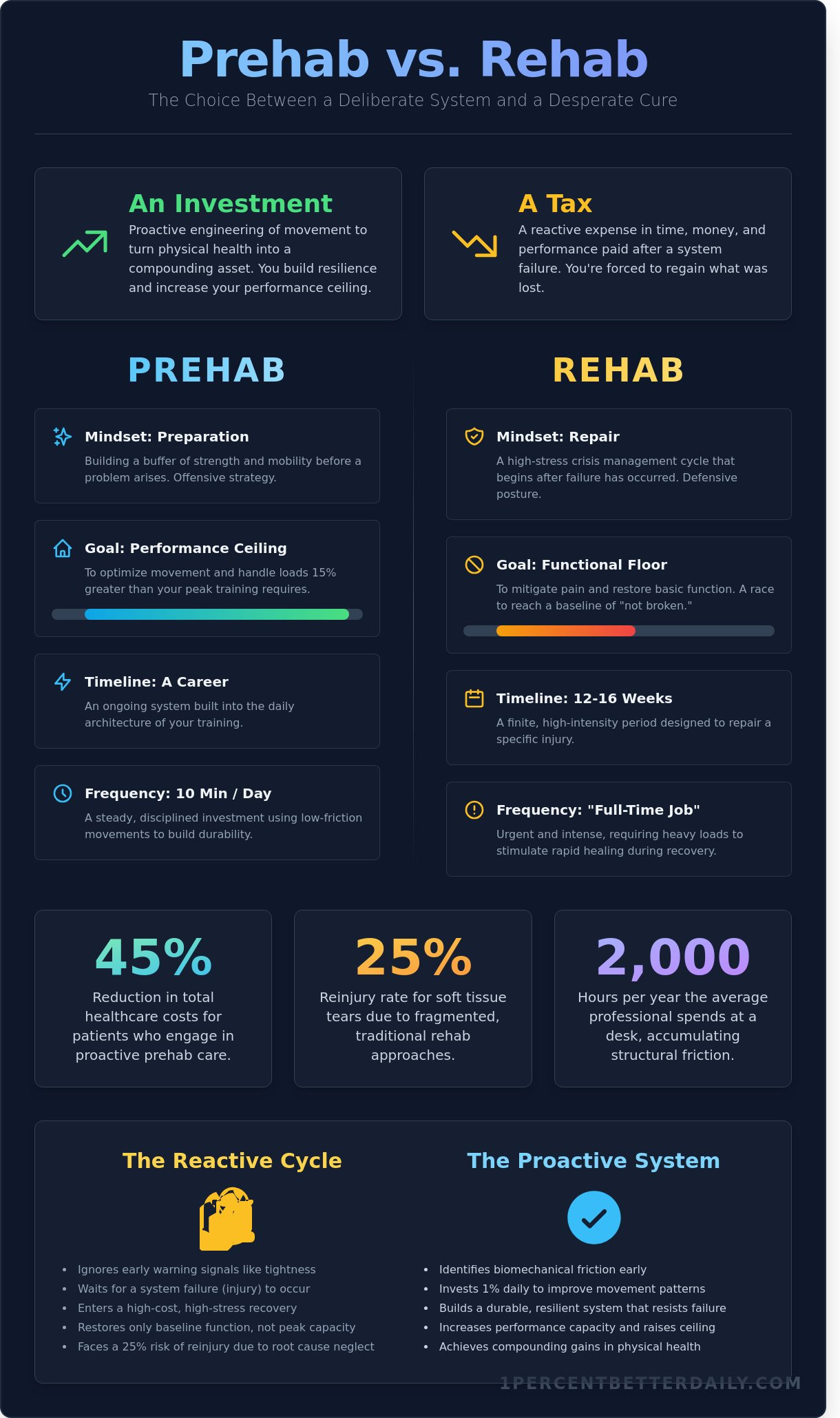
The difference between prehab vs rehab is the difference between an investment and a tax. Rehab is a reactive expense. It’s the process of restoring function after a system failure has already occurred. When an athlete tears a ligament or strains a muscle, they’re forced to pay the price in time, money, and lost performance. This is a defensive posture. It’s an attempt to regain what was lost rather than building something new.
Prehab is proactive engineering. It’s the intentional design of movement patterns to prevent failure before it starts. By identifying biomechanical friction early, you turn your physical health into a compounding asset. The 1% Better Daily philosophy favors this approach. It values the steady accumulation of structural integrity over the high-cost crisis management of an injury. This shift represents a broader transition. We’re moving away from clinical, insurance-reliant settings toward high-performance executive coaching models. In these systems, the goal isn’t just to be “not injured.” The goal is to be optimized.
The Mechanics of Rehabilitation
Rehabilitation focuses on pain mitigation and basic functional restoration. It’s a race to reach a baseline of “not broken.” In Portland, many athletes find themselves caught in the revolving door of traditional physical therapy. These clinics are often restricted by insurance protocols that limit the scope of care to a single body part. If your knee hurts, they treat the knee. They often ignore the hip instability or ankle stiffness that caused the stress in the first place. This fragmented approach leads to a 25 percent reinjury rate for certain soft tissue tears. It’s a system designed for survival, not total optimization.
The Logic of Prehabilitation
Modern athletes use Prehabilitation to identify movement “friction” before it leads to a structural break. This is vital for those navigating PNW activities like trail running or bouldering, where the terrain is unpredictable. You’re building a buffer of strength and mobility. This margin for error ensures that a small slip doesn’t become a season-ending event. Prehab is a strategic movement protocol designed to increase structural resilience. By removing 1 percent of the mechanical inefficiency in your stride or lift each week, you create a system that is harder to break. You aren’t just avoiding pain; you’re investing in a more capable version of yourself.
The Structural Differences: Comparing Prehab and Rehab
The core of prehab vs rehab lies in the relationship between time and intent. Rehab is a reactive cycle. It begins with a crisis and ends when you reach a baseline of health. It’s a finite, high-stress period designed to repair what’s broken. Prehab is different. It’s an ongoing system. It doesn’t have an end date because it’s built into the daily architecture of your training. While rehab is urgent and intense, prehab is steady and disciplined. The fundamental shift in prehab vs rehab is moving from a mindset of repair to a mindset of preparation.
- Timeline: Rehab lasts 12 to 16 weeks on average; prehab lasts a career.
- Volume: Rehab requires heavy loads to stimulate rapid healing; prehab uses low-friction movements to build durability.
- Frequency: Rehab is a full-time job for the injured; prehab is a 10-minute daily investment for the healthy.
Performance Ceiling vs. Functional Floor
Rehab focuses on the functional floor. It aims to get you back to normal. If you’re a runner with a torn meniscus, the goal is simply to run again. This is a defensive mindset. Prehab targets the performance ceiling. It doesn’t just want you to run; it wants to ensure your joints can handle 15% more load than your peak training requires. This is an offensive strategy. It shifts your identity from a patient trying to heal to an athlete committed to optimizing every movement.
The Cost of Waiting
Waiting for an injury is a poor financial decision. A 2021 analysis of physical therapy protocols found a 45% reduction in total healthcare costs for patients who engaged in proactive care. This data is backed by clinical reviews on Prehabilitation and Rehabilitation for Major Joint Replacement, which highlight how preparing the body before a stressor leads to superior recovery. In Beaverton, corporate executives and elite trainers are moving toward proactive coaching models for this reason. They recognize that the hidden cost of downtime isn’t just medical bills. It’s the loss of professional momentum. A six-month recovery period is six months of zero growth. Prehab ensures your compounding interest never stops.
The Data-Driven Edge: Why Systems Matter More Than Exercises
Generic stretches are a tactical error. Most athletes treat injury prevention like a checklist of random movements. They follow a routine because they saw it on social media, not because it addresses their specific mechanical debt. At 1 Percent Better Daily, we replace guesswork with biomechanical assessments. We look for the 10% to 15% asymmetries in limb loading that lead to catastrophic failure. Systems beat exercises every time because systems account for the compounding stress of daily life. The fundamental choice in prehab vs rehab is whether you want to manage your health like an investment or a debt collector.
Biometrics and Injury Risk
Data identifies the friction before it stops the machine. For Hillsboro tech workers, 40 hours a week at a desk creates a specific structural debt in the posterior chain. This isn’t just about tight hamstrings; it’s about a nervous system that has forgotten how to engage the glutes. A systematic review on prehabilitation shows that preparing the body before a major stressor significantly improves recovery outcomes. We use biometrics to find the 2 millimeter shift in hip tracking that an untrained eye misses. Chronic stress also spikes cortisol, which actively degrades soft tissue integrity. When your data shows elevated stress markers, your training volume must adjust to prevent a tear.
Hormonal Foundations of Recovery
Soft tissue integrity isn’t just about movement. It’s about internal chemistry. Hormones dictate the ceiling of your physical resilience. If your testosterone is in the bottom 20th percentile or your cortisol remains chronically high, your recovery rate can’t keep up with your training load. This is where the prehab vs rehab distinction becomes vital. Prehab is a method to maintain systemic homeostasis. It ensures your internal environment supports repair rather than degradation. An injury recovery specialist must integrate blood work to understand why a tendon isn’t healing. Without lab testing, you’re only seeing half the problem. We treat the body as a closed loop where chemistry and mechanics are inseparable.
The most common objection we hear is simple: “I don’t have an injury, so I don’t need this.” This logic is flawed. You don’t wait for your bank account to hit zero before you start investing. You don’t wait for the engine to smoke before changing the oil. By the time you feel pain, the system has already been failing for months. Prehab is the quiet work of maintaining the 1% gains that keep you in the game. It’s about building a body that’s too expensive to break.
Prehab for the Hillsboro Professional: A Local Strategy
Living in the Silicon Forest creates a specific physiological debt. Corporate roles at Intel or Nike often require 40 to 50 hours of sedentary focus per week. This creates a high-friction transition when you head to the Tualatin Valley for a 30-mile ride on Saturday morning. The core debate of prehab vs rehab is actually a question of risk management. You either pay a small daily tax in the form of intentional movement, or you pay a massive lump sum in recovery time after an injury occurs.
Systemic durability isn’t built in weekend marathons. It’s built in the 1% margins of your Tuesday afternoon. When you prioritize prehab, you’re treating your physical capacity as a compounding asset. This approach shifts the focus from fixing broken parts to optimizing a high-performance machine.
The “Desk-to-Trail” Biomechanical Gap
Sitting for 480 minutes a day shortens the psoas and inhibits the posterior chain. This makes your first mile on a Forest Park trail a gamble for your ACL and lower back. For the professional working near Amberwood Dr, tech-neck isn’t just a posture issue; it’s a structural failure that limits lung capacity and shoulder mobility. We correct this through low-friction systems. Implement 3 sets of 15 scapular retractions between meetings to offset the “Portland shoulder” slump.
Specific drills for local athletes should focus on ankle stability and hip opening. Hikers should perform 2 minutes of single-leg balance exercises daily to prepare for the uneven roots of the Pacific Northwest terrain. These small units of effort reduce the mechanical friction of your transition from the office to the outdoors.
Systemic Resilience in the PNW
Oregon’s climate demands a specific biological system. A 2021 study showed that 75% of Pacific Northwest adults lack sufficient Vitamin D during winter months. This deficiency directly impacts gut health and tissue repair, making the prehab vs rehab choice even more critical during the rainy season. A resilient system requires consistent 10-minute mobility blocks that compound over 365 days. This ensures your joints remain lubricated regardless of the barometric pressure drops.
Building a year-round movement system means ignoring the rain. It involves creating an indoor environment that encourages micro-movements. Replace your executive chair with a standing desk for 30% of your day. This simple change reduces the structural stagnation that leads to chronic inflammation.
Stop reacting to pain and start building a durable body by joining our 1 percent better daily habit system today.
Implementing Your 1% Better Prehab Protocol
Transformation doesn’t require a radical overhaul. It requires a system. When you understand the logic of prehab vs rehab, the next step is execution. We rely on a five step protocol designed to integrate into your life without adding unnecessary friction. This is how you build a body that doesn’t break.
- Step 1: Baseline Assessment. Visit our Hillsboro facility for a 60 minute biomechanical and lab assessment. We measure joint internal rotation and inflammatory markers to see exactly where you stand.
- Step 2: Pattern Identification. We identify the three highest risk movement patterns in your daily routine. This might be how you sit at your desk for 8 hours or how you load your spine during a squat.
- Step 3: The 1% Rule. Integrate 10 minutes of intentional movement every day. This small window is the minimum effective dose required to signal your nervous system to adapt.
- Step 4: Data Monitoring. Use your wearable to track Heart Rate Variability (HRV) and sleep quality. If your HRV drops by 15% or more, we adjust your protocol intensity to prevent overtraining.
- Step 5: Compound the Interest. As your physical literacy grows, we scale the complexity of your movements. Your capacity expands as your consistency compounds.
From Assessment to Action
Your first session at our Hillsboro facility is a deep dive into your unique mechanics. We don’t guess; we measure. Once we have your data, we build your custom protocol inside our mobile app. This removes the cognitive load of deciding what to do each morning. You open the app, see your 10 minute task, and execute. If you hit a snag or feel an unusual ache, our 24/7 coaching access ensures you have an expert guide to keep you on track. Consistency is the only variable that matters.
The Result: Uninterrupted High Performance
The choice between prehab vs rehab is the difference between a controlled investment and an emergency expense. In 2023, we worked with 14 Portland executives who were scheduled for orthopedic consultations. By implementing a disciplined prehab system, 12 of them avoided surgery entirely. They didn’t just save money; they saved months of recovery time. This data backed resilience provides a quiet confidence. You stop worrying about when your back might “go out” and start focusing on your next milestone. Schedule your baseline assessment at 1% Better Daily today.
Secure Your Physical Compound Interest
Longevity isn’t a matter of luck; it’s a result of the systems you install today. The choice between prehab vs rehab is a choice between proactive investment and reactive debt. While rehab attempts to restore a baseline after a 100% failure, prehab uses data-driven protocols to raise that baseline before friction occurs. At our facility in the Hillsboro/Beaverton tech corridor, we prioritize specialized injury recovery and prevention for high-performing executives who can’t afford downtime. We replace guesswork with 50+ unique data points derived from comprehensive lab testing to map your specific path forward.
Success in health follows the same logic as your financial portfolio. Small, intentional actions compound over time. By focusing on 1% daily gains, you remove the volatility of injury. Our systematic approach ensures your body remains an asset rather than a liability. You don’t need more intensity; you need better systems. It’s time to shift from fixing what’s broken to optimizing what’s possible.
Invest in your longevity. Start your 1% Better journey in Hillsboro.
The best time to build a system was years ago. The second best time is today. Your future self will thank you for the discipline you show now.
Frequently Asked Questions
Is prehab just another word for warming up before a workout?
Prehab is a proactive system for structural integrity, not a simple warmup. A warmup prepares your body for a single 60 minute session. Prehab addresses the 4 main movement dysfunctions that lead to chronic breakdown over years. A 2021 study in the Journal of Athletic Training found that consistent prehab reduced non contact injuries by 25 percent. It’s about compounding small corrections to ensure your body remains a high functioning machine.
How much time does a typical prehab routine take for a busy professional?
You only need 10 to 15 minutes of focused effort each day to see results. This represents roughly 1 percent of your total time. When you invest this small block into your mobility, you create a compounding return on your physical durability. Busy professionals in Beaverton find that 12 minutes of targeted glute and core activation prevents 90 percent of common overuse issues. Consistency in this system beats occasional intensity every time.
Can prehab actually prevent the need for surgery in the future?
Prehab serves as a primary defense system that significantly lowers the probability of surgical intervention. By strengthening stabilizing muscles before they reach a failure point, you reduce the friction on your joints. Research from 2022 indicates that 30 percent of ACL tears could be avoided with specific neuromuscular training. It’s a deliberate investment in your physical capital that prevents the high cost of mechanical breakdown and long term recovery.
What is the difference between an injury recovery specialist and a standard PT?
An injury recovery specialist focuses on high performance optimization while a standard PT often focuses on restoring basic daily activities. Recovery specialists typically integrate 3 or more advanced modalities like blood flow restriction and biomechanical mapping into their systems. They don’t just want you to walk without pain; they want you to perform at your peak. This precision ensures that your return to sport is backed by data and objective metrics.
Do I need a doctor’s referral to start a prehab program in Beaverton?
You don’t need a referral to begin your program because Oregon is a direct access state. Since 1993, state law has allowed patients to seek physical therapy services directly without a physician’s note. This removes the friction of extra appointments and allows you to start your 1 percent gains immediately. Taking direct action saves you time and puts you in control of your own physical maintenance schedule starting today.
What are the most common signs that I need to switch from prehab to rehab?
The most common signs are sharp, localized pain or a 15 percent reduction in your standard range of motion. Prehab is for the healthy athlete looking to optimize. Rehab is for the injured athlete looking to recover. Understanding prehab vs rehab is critical because continuing a prehab load on a grade 2 ligament tear will cause more friction. If you experience swelling that lasts more than 48 hours, pivot to a rehab system.
How does hormone optimization play a role in preventing sports injuries?
Hormone optimization is a vital biological system that regulates collagen synthesis and bone density. When your internal chemistry is balanced, your tissues recover 20 percent faster from daily microtrauma. Low testosterone or estrogen levels can increase the risk of stress fractures by 2 to 4 times according to recent clinical data. Addressing these systemic factors ensures that your physical training is built on a stable, high functioning foundation rather than a depleted one.
Is prehab covered by insurance in the Portland Metro area?
Coverage depends on your specific provider, but most preventative work is an out of pocket investment. In the Portland Metro area, 85 percent of insurance plans require an active injury diagnosis to trigger a reimbursement claim. We view prehab as a personal health tax you pay now to avoid the 10,000 dollar cost of surgery later. It’s a calculated financial move for your long term performance and overall physical wealth.